
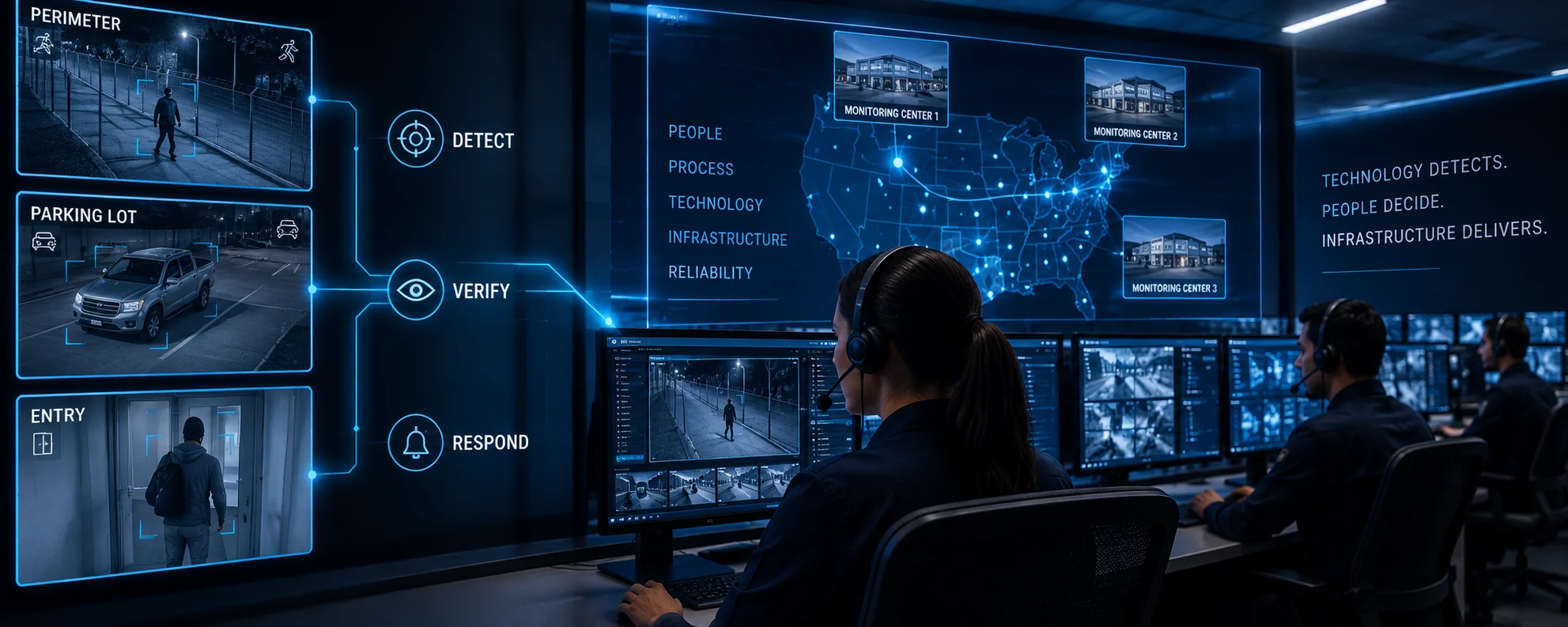
Video monitoring technology has advanced dramatically. Today’s systems can detect movement, identify activity within defined areas, distinguish objects, analyze behavior, and deliver video to a monitoring center within seconds. Those capabilities are changing what security dealers can offer their customers.
But they also raise an important question: What happens after the technology detects something? Because a camera can see an event. Analytics can identify it. Software can generate an alert. But delivering dependable protection requires something more. It requires an operation capable of turning that information into the right response.
Detection Is Only the Beginning
Much of the conversation around video monitoring focuses on cameras and analytics. Resolution. Artificial intelligence. Object detection. Perimeter analytics. Cloud platforms. All of those technologies matter.
When a customer chooses professionally monitored video, they’re trusting more than a camera. They’re trusting everything behind it.
But from the customer’s perspective, none of them represent the final outcome. Customers aren’t buying an alert. They’re buying protection. That means the real value of a video monitoring solution depends on what happens between the moment an event is detected and the moment someone takes action.
Verification Changes the Equation
Traditional alarm monitoring often begins with a signal. Video adds context. When trained operators can see what is happening at a protected property, they can make more informed decisions about the event in front of them. Is someone legitimately on the property? Is there suspicious activity? Is a vehicle entering a restricted area? Is an individual lingering after hours? Does the situation require intervention or emergency response? That visual information can help eliminate uncertainty and provide responders with a clearer understanding of what they may encounter. Video doesn’t simply add another signal. It adds information. And better information can lead to better decisions.
Technology Still Needs Human Judgment
Artificial intelligence and video analytics are becoming increasingly sophisticated. They can help identify activity faster, filter events, and focus attention on situations that may require action. But monitoring isn’t simply an exercise in detection. Context matters. A person walking across a parking lot at noon may be completely normal. The same activity inside a secured perimeter at 2 AM may require immediate attention. A vehicle may belong to an employee. Or it may not. An object detected by analytics may represent a legitimate threat—or an everyday event. Technology helps surface the event. A trained monitoring professional helps determine what it means. That combination of technology and human judgment is one of the most powerful advantages of professionally monitored video.
The Operator Is Part of the Technology
It’s easy to think of monitoring operators as separate from the technology platform. In practice, they are part of the solution. Operators need to know how to evaluate video quickly, follow site-specific instructions, communicate effectively, escalate events appropriately, and remain composed when an incident becomes critical. That requires training. It requires experience. And it requires repeatable processes designed to create consistent outcomes. For dealers, operator quality matters because the monitoring center ultimately represents their brand when an event occurs. The customer may have purchased the system from the dealer. But during a critical event, the monitoring professional becomes part of the customer’s experience with that dealer.
Reliability Extends Beyond the Camera
A sophisticated camera system is only one component of a dependable video monitoring solution. Behind it must be an operational infrastructure capable of supporting monitoring continuously. What happens if a monitoring location experiences an outage? What happens during severe weather? What happens when call and signal volume suddenly increases? What happens if systems or communications are disrupted? These questions aren’t as visually exciting as AI analytics or next-generation cameras. But when protection matters, they’re critical. True reliability requires redundancy, operational planning, trained personnel, and infrastructure designed to continue functioning when conditions are anything but normal.
Why Redundancy Matters
Redundancy is often discussed as a technical specification. Its real purpose is continuity. A resilient monitoring operation should be designed so that a single facility or operational disruption does not become a single point of failure. CMS operates three fully redundant monitoring centers, providing an infrastructure designed to support continuous critical monitoring operations. For dealers, that infrastructure provides something technology specifications alone cannot: confidence. Confidence that the monitoring operation behind their customers is designed around continuity. Confidence that experienced professionals are available around the clock. And confidence that when a critical event occurs, the systems and people needed to respond are ready.
Consistency Is an Operational Advantage
Reliability isn’t only about surviving major disruptions. It’s also about delivering consistent performance during ordinary events, every day. The same processes. The same level of attention. The same disciplined response. Again and again. For security dealers, consistency becomes especially important as video monitoring programs grow. A handful of monitored cameras is one thing. Hundreds or thousands of cameras across multiple customers, locations, technologies, and response protocols create a much more complex operational environment. Scaling that environment requires systems and procedures capable of maintaining service quality as volume increases. That’s where monitoring operations become a strategic part of the video solution.
What Dealers Should Ask Their Monitoring Partner
When evaluating video monitoring, it’s natural to ask about technology. But dealers should also ask about the operation behind it. How are video events handled? How are operators trained? What happens when an event requires escalation? Can response protocols be customized? How does the monitoring center maintain continuity during an outage? What redundancy is built into the operation? Can the monitoring infrastructure scale as the dealer’s video business grows? The answers can reveal just as much about the quality of a video monitoring solution as the camera or analytics platform itself.
Why CMS
CMS approaches video monitoring as more than a technology service. It’s a critical monitoring operation. That means combining video technology with trained professionals, established response procedures, dealer-specific protocols, and resilient infrastructure. Behind those operations are three fully redundant monitoring centers and more than four decades of experience protecting critical accounts. The objective isn’t simply to receive more video events. It’s to help dealers turn those events into meaningful action while providing the reliability their customers expect. Because when a customer chooses professionally monitored video, they’re trusting more than a camera. They’re trusting everything behind it.
The Future of Video Monitoring Is Operational
Cameras will continue getting smarter. Analytics will continue getting faster. Artificial intelligence will continue improving what video systems can identify. But those advancements don’t diminish the importance of monitoring operations. They make them more important. As systems generate better information, dealers need monitoring partners capable of turning that information into better outcomes. Technology detects. People evaluate. Processes guide the response. Infrastructure keeps everything working. Together, they create something much more valuable than video alone: dependable protection.